A packing list becomes a customs declaration
Kella reads an importer's packing list and commercial invoice, classifies every line against HS 2022, and produces an ordered declaration with a duty and tax estimate — work that clearing agents do by hand, line by line.
- Status
- In development
- Client
- Appable Technologies
- Sector
- Trade & Logistics
- Year
- 2026
Built with
- Next.js
- PostgreSQL
- Supabase
- AI extraction
- pnpm monorepo
Disciplines
- Product Design
- AI Document Extraction
- Multi-tenant SaaS
- Customs & Tax Logic
- Test Engineering
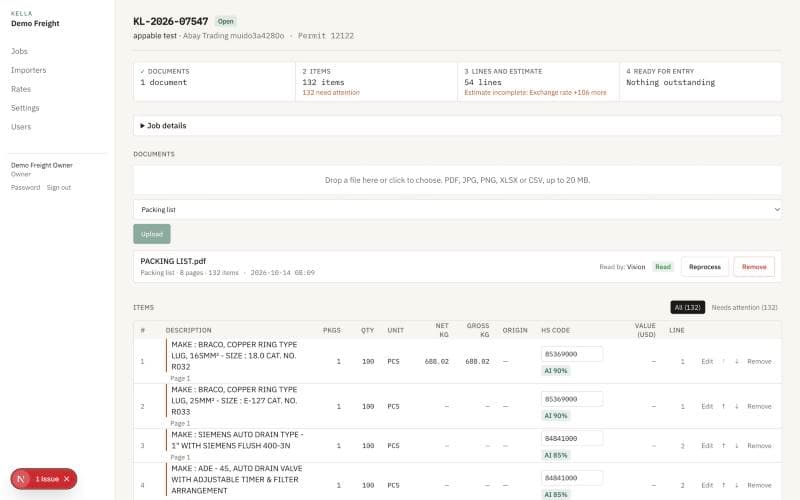
A customs clearance workspace. Reads an importer's packing list and invoice, classifies each line against HS 2022, orders the declaration lines and estimates duty and tax with the working shown.
Ethiopian customs clearance runs on retyping. An importer sends a packing list and an invoice; a clearing agent reads them, works out an HS code for every item, orders the lines, estimates the duty and tax, and enters the result on the customs platform. It is skilled work, and almost all of it is transcription.
The challenge
Document extraction is where tools like this usually overreach. Send every page to a language model and you get fluent, confident, occasionally wrong numbers — which in a customs declaration is the one failure mode you cannot absorb.
The approach
Rules first, AI second. Every document is read by pattern rules, and AI is used only where the rules give up. A scanned document is accepted from the rules only under a stricter test: high OCR confidence, no HS-code column, digits-only numbers, and a printed total for every numeric column that reconciles against the lines exactly. Anything that fails goes to AI, and anything AI touches is marked for a human to confirm. For HS codes the order is explicit — a printed code wins, then an AI suggestion, then a reviewer's correction, and every code must resolve to a valid HS 2022 heading.
The build
The unit of work is the import job: one import under one permit, holding its documents, items, declaration lines and estimate. Invoice lines are matched back to packing-list items so value, unit price and country of origin flow through, with a panel for matching the ones that do not. Per job, the agent chooses whether items sharing an HS code and unit merge into a single line, and whether lines follow packing-list order or HS order. Duty and tax come from the tenant's own rate table with the working shown, and a CFR or CIF invoice is worked back to its FOB value where the setting calls for it.
Every customer gets a fully isolated database rather than a shared one with a tenant column — in a product holding other companies' commercial documents, isolation is a feature you can explain to a buyer. Sixty-two test suites cover the pipeline, including tenant isolation itself.
Where it stands
In active development. An Excel export of the ordered lines and estimate is working; a browser extension that fills the customs item form directly is next.
Start now. Be live in weeks
One conversation, a straight assessment, and a written scope you own whether or not you build it with us.